The UK Government Just Published an AI Plan for Agencies. Here’s What It Actually Says.
The UK government has published an AI adoption plan specifically for the creative industries — and if you run a marketing agency, a design studio, or a video production company, this document is talking directly about you.
I’ve read the whole thing so you don’t have to. Here’s the honest version, not the press release version.
What the Report Actually Is
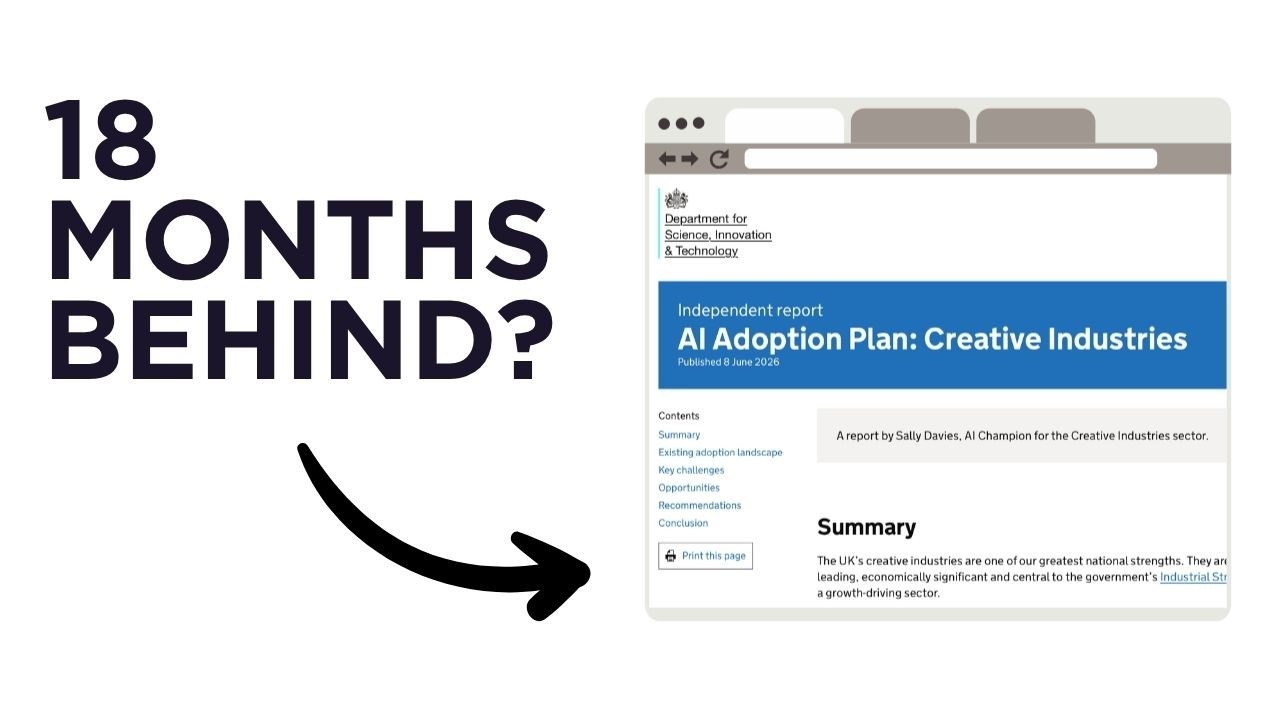
This was published on the 8th of June by the Department for Science, Innovation and Technology. It was written by Sally Davies, the government’s AI champion for the creative industries, and it’s part of a wider set of sector-specific AI adoption plans the government has been putting together.
It’s not a funding announcement or a policy directive. Think of it as an official signal — the government saying: this is real, this matters, and here’s what we think you should do about it.
The Numbers Worth Paying Attention To
The headline stat is this: 51% of creative businesses report using AI, compared with 33% of all businesses across the economy. So the creative sector is actually ahead of the national average — which might surprise some people.
But the more important number is buried underneath that one.
Adoption is deeply uneven. Larger businesses are moving fast. Smaller firms and micro-businesses — which is most agencies — are roughly 18 months behind. And the main barrier isn’t a lack of interest. The report is clear on this: it’s a lack of capacity, confidence, and not knowing where to start.
If that sounds familiar, that’s the point.
Augmentation First
The approach the government is backing has a name: augmentation first.
The idea is that AI should support human creativity, not replace it. The goal is to help creative workers spend more time on the creative parts of their job and less time on the admin, the repetitive tasks, the back-office work that eats away at your week.
I think that’s completely the right way to look at it — and there’s a case study in the report that illustrates it well.
The Aardman Example
Aardman — the studio behind Wallace and Gromit — brought in an AI tool called Copycat that now handles around 70–80% of a specific post-production process. VFX staff who previously did all of that work manually no longer have to.
The creative work didn’t go away. The repetitive work did.
That’s the model. That’s what this should look like in practice for most agencies.
What This Means for Your Agency
Most small agencies right now are using AI for back-office tasks: drafting emails, summarising briefs, basic research. That’s a fine starting point — it’s actually where most people begin.
But the report is pointing towards the next step: getting AI into your actual workflows. Your proposals. Your client delivery. Your account management. The things that actually take time.
The agencies that figure that out in the next 12 to 18 months are going to have a serious advantage over the ones that don’t — because they’ll be able to take on more work without hiring more people. In a market where margins are tight and clients want more for less, that really matters.
The Agency AI Operating System
Reading this report reminded me of something I’ve been building for my own business over the past several months: what I’d call an agency AI operating system.
It’s not a single tool. It’s a workspace — built in Claude — with a large amount of context about the business baked in: the brand, the ideal clients, the services, the processes. That context means I don’t have to keep explaining myself every time I want to use AI for something. The results are faster and more useful because the system already understands the business.
On top of that context, I’ve connected a range of tools — for research, lead generation, content, delivery — using Python scripts and JavaScript to tie things together.
I’ve taken a snapshot of the parts I think would be most useful as a starting point for agencies and put together content to walk through how it works. That’s what this video is the beginning of.
What Actually Moves the Needle
The government’s plan is well intentioned. The fact that they’re treating this as a priority is genuinely useful — it confirms this isn’t a fad.
But a document won’t install anything in your business.
What actually moves things forward is simpler: sit down, map out where your time goes, and work out which parts AI could realistically take off your plate. That’s it. Not a grand transformation plan — just an honest audit of where the friction is.
If you want help doing that, I’m offering a free AI opportunity audit to a handful of agencies. No pitch. Just a practical conversation about where AI could make a real difference for your business. The link to get in touch is in the video description.
The agencies that win over the next couple of years won’t be the ones who waited for a government plan. They’ll be the ones who just got started.
If there’s a specific part of the agency AI operating system you’d like to see covered — the tools, the workflows, how to build the context layer — leave a comment on the video. I’m making more content on this and want to cover what’s actually useful.